Melukat has moved from something visitors read about to something a great many of them now do, and that shift has brought a problem with it: a sacred ritual being approached as a photograph. It is worth being clear from the outset. Melukat is a living Hindu religious practice, performed by Balinese people for reasons that matter to them, at sites that are functioning places of worship rather than attractions. Visitors are often genuinely welcome. That welcome comes with expectations. Our guide to Bali’s temples covers temple etiquette in general; this covers the water specifically.
What melukat actually is
The word comes from the idea of removing or shedding, and the ritual uses tirta, holy water, to cleanse a person of spiritual impurity, negative influence and accumulated misfortune. Balinese Hindus undertake it at meaningful moments: before an important ceremony, after illness or bereavement, at particular dates in the ritual calendar, or simply when life feels like it needs resetting.
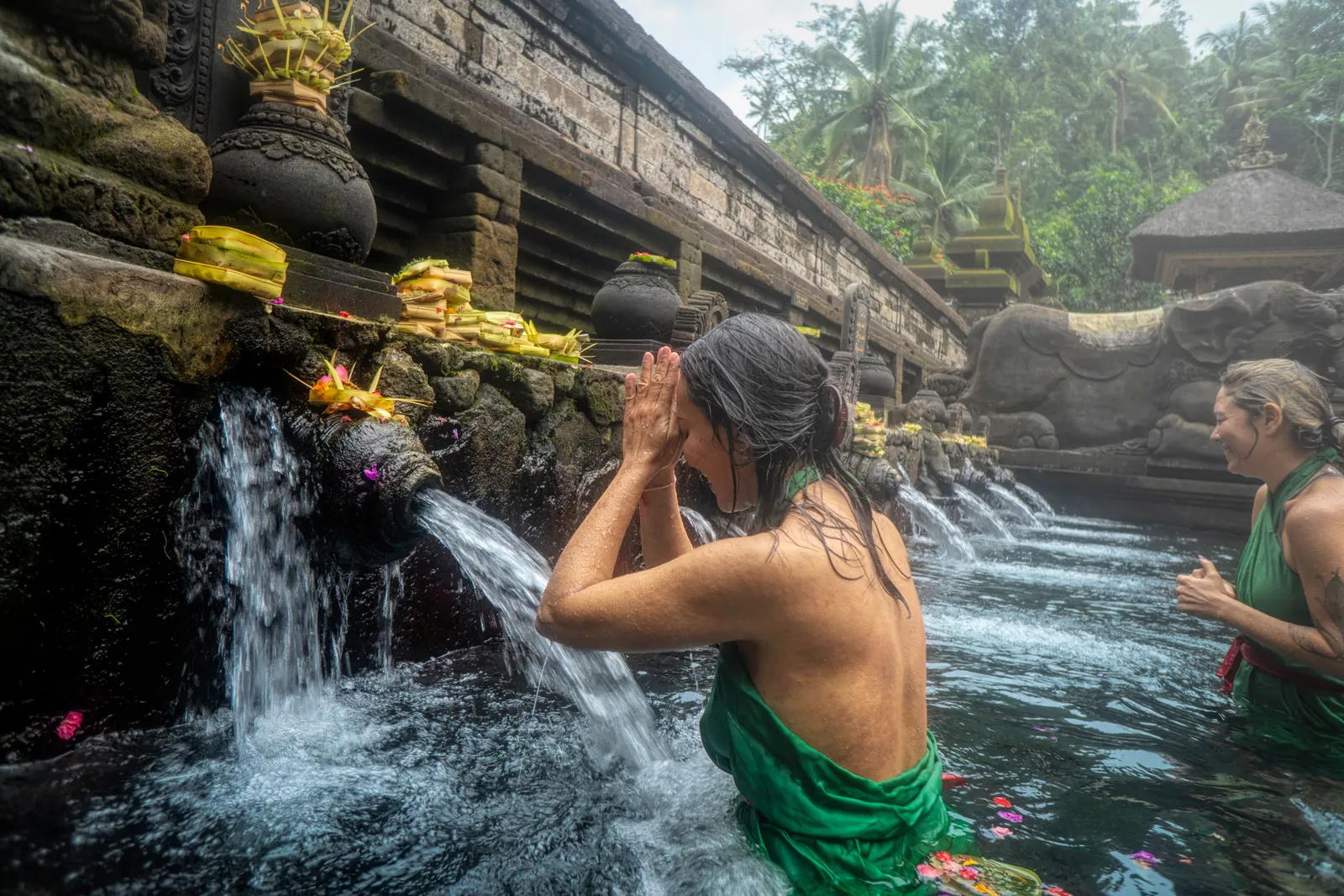
It is performed at springs, rivers and temple bathing pools where the water is held to be sacred. The physical act is straightforward: you move along a line of stone spouts, and at each one you pray, then let the water run over your head. What is not straightforward is the meaning, which is embedded in a religious system with its own calendar, cosmology and rules of purity. You do not need to share the belief to take part respectfully, but you do need to recognise that it is somebody’s faith and not a spa treatment.
This is the distinction that matters, and it is why “wellness melukat” packaging is worth approaching with some care. There are legitimate guided ceremonies led by priests, and there are operators selling the aesthetics of one.
Where visitors can genuinely take part
Tirta Empul, near Tampaksiring and a short drive from Ubud, is the best known and the most accustomed to visitors. Its long rectangular pools, fed by a natural spring, have a line of carved spouts that worshippers move along in sequence, and foreign visitors join that line alongside Balinese families. It is busy, particularly in the middle of the day, and it is the site where the balance between participation and spectacle is most visibly tested.
Several other spring sites around the island also receive visitors, some quieter and more traditional, where the ceremony is led by a local priest and arranged in advance rather than joined on arrival. Whether a guide or priest is required genuinely varies from site to site, so ask before you go rather than assuming the Tirta Empul model applies everywhere.
If you are basing yourself inland, most of these sites are within reach of Ubud, and our Ubud guide covers the drive times and how the surrounding villages fit together.
What to wear, and what to bring
The temple dress code applies before you get anywhere near the water. You need a sarong tied at the waist and a sash over it, with shoulders covered. This is not optional and it is not softened for visitors: covering the legs below the knee and wearing proper temple attire is the baseline expectation at Balinese sacred sites, and Bali’s tourist conduct rules have made that expectation explicit in recent years.
For the water itself, the usual arrangement is a sarong worn over swimwear or over clothes you are happy to soak. Bring a second dry sarong, a towel and a change of clothes, because you will come out completely wet and the drive back is not comfortable otherwise. Leave valuables in a locker or with someone, since phones and water do not mix and the changing areas at busy sites are basic.
Sarongs are generally available to rent or borrow at the entrance for a small amount in rupiah, and entrance fees at sites like Tirta Empul run to tens of thousands of rupiah per adult. Fees change and differ between sites, so check the figure at the counter and carry small notes, since card payment is unreliable.
A guided ceremony with a local priest changes the experienceAsk what the ritual means rather than copying the person in front of youThe rules that are actually enforced
Some temple rules are politely worded suggestions. These are not.
Menstruating women must not enter temple grounds or sacred water. This is a longstanding element of Balinese Hindu purity custom, it is posted on signs at temple entrances, and it has been restated in the conduct expectations Bali has set out for visitors. It is enforced on trust rather than by inspection, which is exactly why it matters that visitors respect it. The same custom generally asks women in late pregnancy or shortly after childbirth, anyone with an open wound, and the recently bereaved to remain outside.
Beyond that: no climbing on shrines or sacred trees, no smoking or eating within the temple compound, no drone flying over ceremonies, quiet voices, and no stepping in front of people who are praying to get a better angle. Bali has an enforcement task force for visitor conduct at sacred sites and penalties for serious breaches, but the reason to follow these rules is not the penalty.
A note on the rules themselves: several travel sites cite a specific governor’s circular by number when describing them, and those numbers do not agree with each other. The substance of the rules is well established and consistently posted at the sites themselves. If you want the authoritative current text, look at the Bali provincial government’s own material rather than a travel article, including this one.
Participating versus spectating
There is a legitimate version of both, and the difference is worth thinking about before you arrive.
Participating means entering the water in proper dress, following the sequence, praying or standing quietly at each spout, and not photographing your way along the line. If you do not share the faith, the honest posture is respectful attention rather than performance. Many visitors find it genuinely moving on those terms.
Spectating means staying out of the water entirely, watching from the walkways in proper dress, and taking photographs that do not put a camera in a worshipper’s face. This is a perfectly reasonable choice and often the better one if you are uncertain, in a rush, or arriving in the middle of a busy afternoon when the pools are full of people who are there to pray.
What does not work is the hybrid: entering the water in swimwear, filming the whole way, treating the queue as a set. That is the behaviour that prompted the conduct rules in the first place.
Fitting it into a trip
Go early. The sites are quietest in the first hours after opening, the light is better, and you are sharing the water with worshippers rather than tour groups. Allow more time than the ceremony itself takes, because changing, drying off and simply sitting in the temple grounds afterwards is part of it.
Melukat pairs naturally with the slower, inland side of a Bali trip rather than with a packed day of sightseeing, and many people combine it with the retreat and practice culture around Ubud that our yoga guide covers. Treat it as the thing you do that morning, not as one stop on a seven site loop.
And if you take one thing away: ask before you photograph, dress before you are asked to, and if you are unsure whether you should be in the water, stay out of it. Nobody has ever regretted being the visitor who was quietly respectful.